Stani Kulechov V4 thesis makes the clearest case yet for getting the market structure right: the intermediaries between borrower and lender stop being separate fee-taking layers and become roles inside the protocol.
I would push it one layer down. The structure is only as sound as the collateral entering it, and almost all tokenised securities still originate through the exact stack V4 dissolves.
A token minted at the end of an offchain origination chain does not give you the atomic settlement, continuous margining and live transparency that make Aave Labs V4 valuable. Pantera Capital Q1 report puts 77.6% of tokenised assets in the Wrapper tier and only 2.7% in the Native tier, where the asset is born onchain and consensus compute governs issuance, redemption and composability. The names that clear that bar are mostly DeFi's own, Sky Ecosystem's USDS and Aave's GHO among them, not tokenised real-world assets. a16z's Guy Wuollet makes it clear: "Debt assets should be originated on chain, not originated off chain and tokenized.". And as Luc Froehlich puts it, wrappers are "a digital skin over a paper-based body".
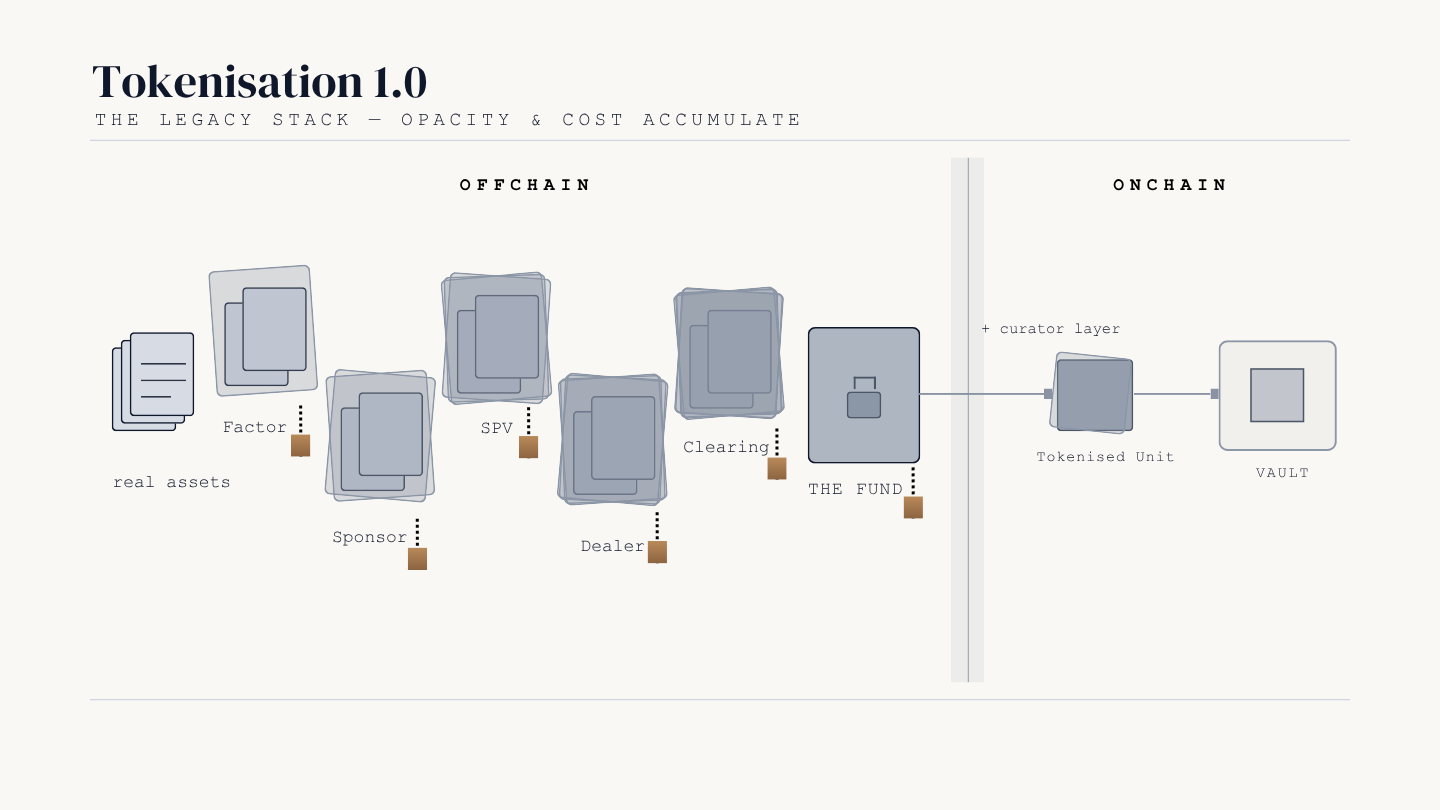
So the question onchain DeFi infrastructure brings up is whether a security can be created so that its provenance, its obligor and its risk are native onchain state from inception.
That is what onchain origination means, and it outlives any one protocol: a financing layer, V4 or otherwise, can only be as transparent, atomic and continuously priced as the collateral feeding it.
You need both: financing rails downstream, and origination upstream producing collateral worthy of them.
Start from the asset. To be native onchain, the data used for a security to originate must behave almost like a blockchain transaction before it reaches a chain. Call it the Origination Data Package (ODP), the bundle of commercial facts and consents that constitutes the asset. Three properties make it usable:
1. Machine-readable intent. Structured data, not a paper trail or fragments, so a smart contract can act on it without a human in the loop.
2. Cryptographically verifiable signatures with legal value. Both verifiable and legally enforceable, so the onchain record is the instrument itself, not a hash pointing at one held elsewhere.
3. Privacy fit for onchain use. Commercial terms cannot sit in public, so the package must support selective disclosure, exposing only the fields a counterparty is entitled to see.
Get those three right and origination stops being an offchain event attested after the fact.
Origination quality also decides which risk mechanism is even available. For liquid securities and crypto, liquidation is the core mechanism: a protocol over-collateralises, marks to a live market, and sells once collateral breaches a threshold. Take away the deep market and that mechanism has nothing to act on, the position most real-world assets are in.
Traditional finance has securitisation, built to mutualise risk across many assets rather than liquidate any one. But offchain it relies on two moves that cut against transparency: the law of large numbers, which works precisely because the individual asset is obscured inside the pool, and tranching into senior and junior risk.
Tranching is one thing onchain programmable money makes efficient, such as Strata automates the senior and junior split entirely onchain. But that does not fix the layer beneath it. The moment you pool, you are back to a bundle whose individual quality is invisible, the exact opacity native origination set out to remove. And pooling means warehousing assets first, parking capital that bleeds yield, so the lender never sees the optimal rate.
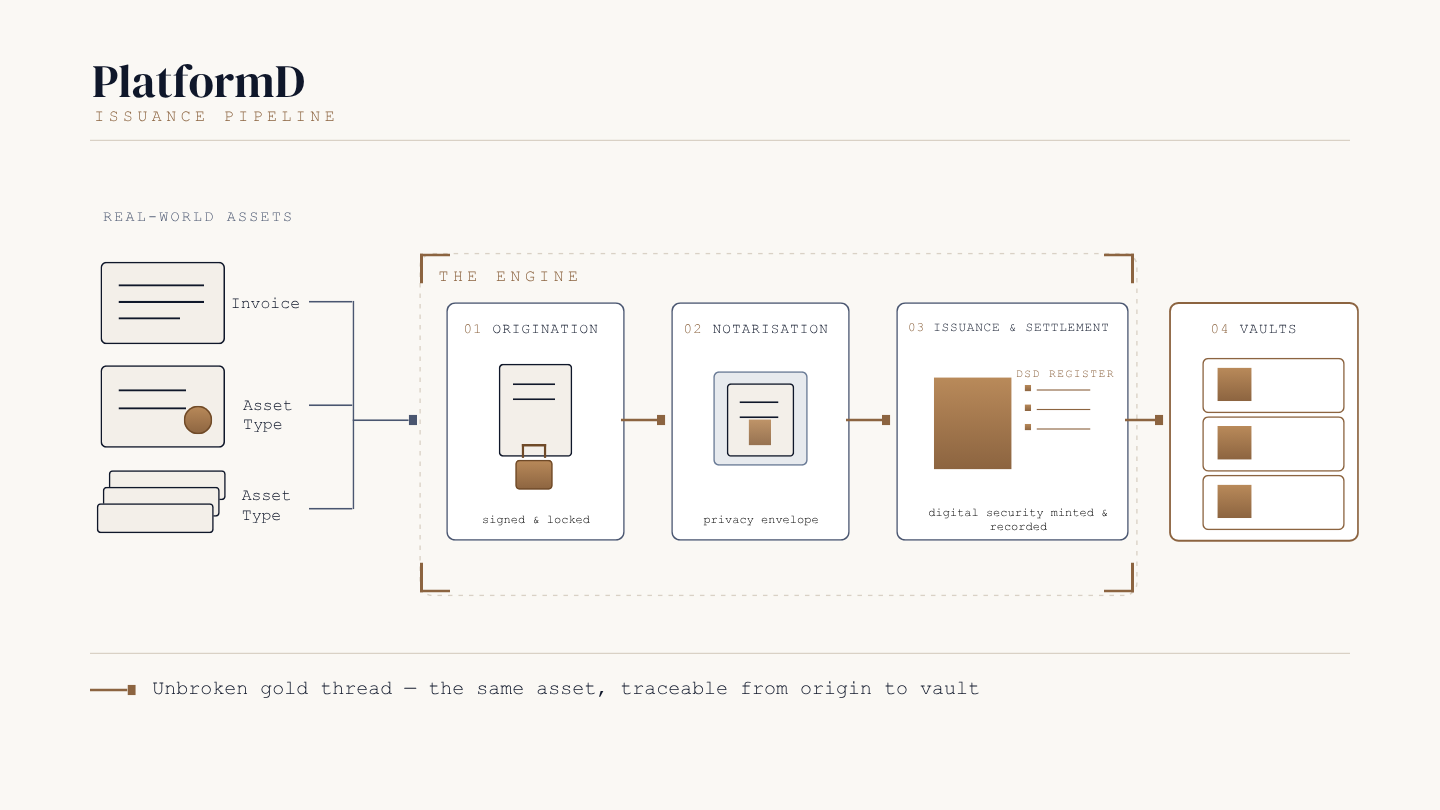
This is the bet we are making at PlatformD, and why we started with the invoice. It looks hard to originate trade receivables onchain, fragmented, bilateral, buried in back-office formats, but regulation is turning it into the cleanest ODP available, at scale. It now passes all three tests:
1. Machine-readable. Mandatory electronic invoicing makes it structured data at source.
2. Signed with legal value. Digital signatures carry legal force across jurisdictions, eIDAS 2.0 being one example among several, with verifiable organisational identity through vLEI binding each party via a DID or a registry of legal entities.
3. Privacy-ready. Notarised through selective disclosure, so only the fields a counterparty needs are exposed.
From there a single confirmed invoice becomes a single-obligor zero-coupon digital security, issued natively on a Digital Securities Depository, a new Bank of England FMI being tested in the DSS - an onchain alternative to a CSD. There is no analogue asset beneath the token. The security is the asset.
Rather than pool, we securitise individually and mutualise another way: not through tranches but a real-time risk engine and a shared credit-enhancement layer. A trade receivable is self-liquidating: it matures, the named obligor pays, and the right response to deterioration is credit enhancement, not a fire sale into a market that does not exist. The engine reads live data to decide which obligors to accept and at what yield. The result is mutualised risk without the opacity of a pool or the drag of warehousing: continuously margined credit enhancement, every security priced on its own named obligor.
Get the market structure right, and you still have to get the asset right. We are building the asset, one invoice at a time, in a multi-trillion market being turned into clean, signed, verifiable data whether the rest of the stack is ready or not.